• Rent vs Buy: The Rule of 240

    The rent-versus-buy debate is one of personal finance’s most exhausting recurring fights. You know the one: everyone you know has an opinion, your parents are sure you’re wasting money on rent (or that you’re drowning in debt if you bought), and somewhere on Reddit there’s a 47-comment thread explaining why both sides are completely wrong.

    As someone tracking every dollar toward a 2030 retirement while living in one of North America’s least affordable cities, I had to cut through the noise. Is my condo an investment? Is it an inflation hedge? Or am I just paying someone — either a bank or a landlord — to have a roof over my head? This post walks through the debate, the math, and a deceptively simple rule that can settle 80% of the argument in about ten seconds.

    Why the Debate Is So Hard (and Why Most People Get It Wrong)

    The fundamental mistake most people make is comparing a mortgage payment to a rent payment. That’s an apples-to-oranges comparison at best, and actively misleading at worst.

    A mortgage payment includes principal (which is forced savings — you’re building equity), interest (the cost of leverage), property taxes, and sometimes insurance. Rent is 100% unrecoverable — you hand over money and walk away with zero equity. But that doesn’t automatically mean buying is better, because ownership has a stack of unrecoverable costs that renters don’t pay directly.

    This is where the frameworks matter — because once you see the real costs, the answer often flips.

    Three Ways to Frame the Question

    Frame 1: The Kiyosaki View (“Your House Is a Liability”)

    In Rich Dad Poor Dad, Robert Kiyosaki famously argued that your primary residence is a liability, not an asset, because it takes money out of your pocket every month without putting any back in. By his definition — an asset puts money in your pocket; a liability takes money out — your home fails the test. It generates no cash flow. It demands repairs, property taxes, insurance, and opportunity cost on the equity you could have deployed elsewhere.

    Is he right? It depends on your definition. This view resonates with the FIRE community because it forces you to ask: what is this asset actually doing for me? If your house costs $3,000/month and generates nothing, it’s a lifestyle expense masquerading as an investment.

    Frame 2: The JL Collins View (“Don’t Buy a House to Get Rich”)

    In The Simple Path to Wealth, JL Collins — the godfather of index fund investing — is blunt: houses are not investments. They’re expensive indulgences. His advice is to buy the minimum home you actually need, not the maximum you can afford, because the stock market historically outperforms real estate over long horizons. He’s owned homes, but he’s never pretended they were his path to wealth.

    Frame 3: The Ben Felix View (“Unrecoverable Costs”)

    Ben Felix, a Canadian portfolio manager with millions of followers on YouTube, introduced what has become the gold standard framework for this debate: the 5% Rule. Instead of comparing mortgage payments to rent, you should compare total unrecoverable costs on both sides. He breaks down the annual cost of homeownership into three buckets that total roughly 5% of the home value:

    • Property tax: ~1%
    • Maintenance and repairs: ~1%
    • Cost of capital / opportunity cost: ~3% (what your equity and interest costs you in foregone investment returns)

    The genius of this framework is that it creates an imputed rent number — the effective cost of shelter you’d pay regardless of whether you rent or own. It’s apples to apples.

    Enter the Rule of 240

    Here’s where it gets stupid simple. Ben Felix’s 5% rule says: take the home value, multiply by 5%, divide by 12. That’s your breakeven monthly rent. But let’s do the algebra once and hard-code it:

    Home value × 0.05 ÷ 12 = Home value ÷ 240

    That’s it. The Rule of 240. Take the purchase price, divide by 240, and you get the monthly rent where owning and renting have roughly equivalent unrecoverable costs.

    The Math, With Examples

    ScenarioHome ValueRule of 240 (Monthly)Verdict if Actual Rent Is…
    Mid-size Canadian city$500,000$2,083Rent < $2,083? Rent. Rent > $2,083? Buy.
    Vancouver 1-bedroom condo$583,000$2,429Rent < $2,429? Rent. Rent > $2,429? Buy.
    Toronto townhome$850,000$3,542Rent < $3,542? Rent. Rent > $3,542? Buy.
    SF Bay Area house$1,500,000$6,250Rent < $6,250? Rent. Rent > $6,250? Buy.

    My Condo, My Math

    I own a 1-bedroom condo in Vancouver valued at roughly $583,000. Using the Rule of 240, my breakeven rent is about $2,429/month. Let’s put that in context: similar 1-bedrooms in my building and neighbourhood are renting for well above that. On pure unrecoverable-cost math, I’m probably on the owning side of the line.

    But here’s the nuance: I’m planning to sell this place in late 2030 or early 2031 and use the equity to fund my retirement. So for me, the condo isn’t just shelter — it’s a concentrated, illiquid position I plan to liquidate to feed my VEQT portfolio. During the years I live in it, it functions as both a consumption good and an asset hedge against Vancouver rent inflation. Once I sell it and dump the proceeds into index funds, it becomes investment capital proper.

    When Renting Wins

    Renting is the better financial choice when one or more of these conditions are true:

    • Your breakeven (price ÷ 240) is well above market rent. This happens in cities with very high price-to-rent ratios. If you can rent a comparable place for $1,500 but the 240-rule says $2,400, renting and investing the difference wins — and the discipline to actually invest that surplus matters. Ben Felix’s analysis of 12 Canadian cities from 2005 to 2024 found that a disciplined renter investing the difference in stocks built about 14% more wealth than the average homeowner over that period.[web:4]
    • You’re planning to move within 3–5 years. Transaction costs (legal fees, land transfer tax, realtor commissions, moving costs) run 5–7% of the purchase price. That’s a massive hurdle to clear if you’re only holding for a few years.[web:11]
    • You want flexibility over stability. If your plan involves slow travel, digital nomadism, or moving between cities, owning anchors you to one very expensive postcode. Renting lets you lease-sprint your way through coffee countries.
    • You don’t invest the surplus. If you’d spend the difference between owning and renting on lifestyle instead of investing it in index funds, the renter’s mathematical edge evaporates.

    When Buying Wins

    • Market rent exceeds your breakeven number. This is often the case in expensive cities where ownership costs are locked in but rents have caught up or surpassed that level. In Vancouver and Toronto, owning has often been cheaper than renting a comparable place, especially if you have a reasonable down payment and a fixed-rate mortgage.
    • You’re staying put for 7–10+ years. The longer you hold, the more the 5–7% transaction costs get amortized across years of shelter. After about five years, homeownership typically breaks even with renting; after ten, it usually wins.[web:14]
    • The hedge value is high for you personally. If you have kids in schools, deep neighbourhood roots, or a career that rewards staying in one place, owning eliminates landlord risk, rent hikes, and the anxiety of not having a home to come back to. Nobody talks about “rent flexibility” when you’re 70 and your landlord wants to renovate or sell.
    • You’re leveraged in a rising market. A 20% down payment means you’re controlling a $500K asset with $100K of your own money. If prices rise 5%, your equity went up 25%. That’s the double-edged sword of leverage.

    The Secondary Test: Price-to-Rent Ratio

    Wealthsimple offers a complementary quick check: divide the home price by annual rent for a comparable place. If the result is around 15 or below, buying likely wins. At 15–20, it’s the gray zone. Above 20–23, renting almost certainly wins. Another framework from the Financial Tortoise walks through a 5-step process combining the 5% rule, price-to-rent ratio, timeline assessment, hidden cost accounting, and lifestyle questions.

    A Caveat on the 5% Rule (and the 240 Rule)

    Ben Felix created the 5% rule when mortgage rates hovered around 3%. Today, with rates significantly higher, some argue the imputed cost should be closer to 7–8%, which would make owning look worse by comparison. The Financial Tortoise notes this caveat explicitly. If anything, in a higher-rate environment, the Rule of 240 may be slightly optimistic about buying — the real breakeven number might be closer to dividing by 150–170.

    That said, having a fixed-rate mortgage insulates you from future rate hikes, while a renter faces annual rent increases with no floor. Both sides have their risks; the rule just gives you a clean starting point.

    Bottom Line

    Your primary residence is not an investment in the portfolio sense — it’s a consumption choice plus an inflation hedge on shelter. Whether buying or renting makes more financial sense depends on your specific city, your timeline, and whether you can compare apples to apples using unrecoverable costs instead of mortgage payments.

    The Rule of 240 won’t give you a perfect answer, but it will give you a starting number in about five seconds. From there, layer in your timeline, your discipline as an investor, and your tolerance for being at someone else’s mercy when your lease comes up for renewal. Sometimes the right answer is the one that lets you sleep at night, not the one that maximizes IRR.


    References and further reading:

    • Ben Felix, “Renting vs. Buying a Home: The 5% Rule” (YouTube, 2019) and “20 Years of Renting vs. Buying a Home in Canada” (YouTube, 2025)
    • Ben Le Fort, “The 5% Rule to Renting Vs Buying a Home” (Substack, 2022)
    • Rational Reminder Podcast Episodes 154, 172, and 325 with Ben Felix
    • JL Collins, The Simple Path to Wealth (book)
    • Robert Kiyosaki, Rich Dad Poor Dad (book)
    • Wealthsimple, “Should You Buy or Rent? A Quick Formula to See”
    • Financial Tortoise, “Rent or Buy — Complete 5-Step Framework” (YouTube, 2026)
    • Globe and Mail, “Turns out that for the right person, renting in the last 20 years was better than buying” (2025)

  • May 2026 Net Worth: Less FOMO, More VEQT

    As of May 1, 2026, my total net worth is $1,305,516.32.

    That’s the headline number, but the more interesting story is what’s happening underneath: my home and crypto both dropped, while my “do‑nothing” automated investments just kept quietly doing their thing in the background.

    This update is part accountability, part behind‑the‑scenes look at how I’m simplifying my portfolio as I march toward financial independence. If you enjoy watching a 50‑year‑old Gen Xer slowly de‑FOMO his portfolio, this one’s for you.


    What changed so far this year?

    Here’s the quick version of the big moves since the last check‑in:

    • Primary residence estimate: $616,000 → $583,000 (a drop of $33,000)
    • Crypto: $53,000 → $44,000 (a drop of $9,000)
    • Overall net worth: still solidly north of $1.3M

    So on paper, I “lost” $42,000 in those two lines. But that’s exactly why I treat both my house and crypto differently from my core investment strategy.


    My home: a conservative hedge, not an investment thesis

    My property is my primary residence, not a flip, not a rental, and not a carefully engineered real estate bet. It’s where I live, sleep, cook, and obsess over spreadsheets.

    Marking it down from $616k to $583k is simply me being conservative with valuation, not an emotional referendum on my future. I’d rather err on the side of underestimating than inflating my ego with a fantasy Zillow number.

    A few points on how I think about my home:

    • It’s a hedge against rent inflation, not my main “get wealthy” asset.
    • Short‑term price moves don’t change my day‑to‑day life at all.
    • As long as I can comfortably afford the carrying costs and stay flexible about where I live in the long run, I’m happy.

    If you’re on your own FI path, I think it’s useful to decide: is your home primarily shelter, lifestyle, or investment? The more you can see it as shelter and a moderate hedge, the less you’ll stress about month‑to‑month valuation swings.


    Crypto: my designated moonshot/fomo bucket

    Crypto has taken a hit this year, dropping from $53k to $44k. That’s a decent percentage move in a short time, but honestly, it barely registers emotionally for me anymore.

    That’s because I’ve made a clear, written decision about crypto in my plan:

    • It’s a moonshot / FOMO bucket, not a core holding.
    • I’m unlikely to add or withdraw from it for the foreseeable future.
    • I fully accept that it could swing wildly or go much lower.

    In other words, I’ve mentally written that money off as experimental capital. If it 5x’s, great. If it gets cut in half, that’s the price of admission for playing in an extremely volatile sandbox.

    This is very different from the way I treat my VEQT contributions and globally diversified index funds, which are the serious, grown‑up part of the portfolio designed to get me to FI.


    The boring hero: automated VEQT contributions

    The real story this year isn’t the drop in house and crypto values. It’s that my new investments are mostly just dollar‑cost averaging (DCA) into VEQT, on autopilot.

    VEQT (Vanguard All‑Equity ETF Portfolio) is basically a one‑fund, globally diversified equity portfolio in a single Canadian ETF. Under the hood, it owns:

    • A broad U.S. total market ETF
    • A Canadian all‑cap ETF
    • Developed markets outside North America
    • Emerging markets exposure

    As of early 2026, VEQT holds around 13,000+ stocks globally, with allocations across U.S., Canada, developed ex‑North America, and emerging markets. In plain English: when I buy VEQT, I’m buying a tiny slice of thousands of companies around the world, in one click.

    Why I like automating into VEQT right now:

    • It massively simplifies my portfolio. One ticker, global equity exposure.
    • It’s rules‑based and low cost, so I’m not wasting energy on constant tinkering.
    • It lets me focus on saving rate and life design, not stock picking.

    For a middle‑aged guy still targeting FI by 2030, this kind of automation is worth more than any clever trade I might make.


    Why automated passive investing works so well

    Since more readers are asking how to start, let me zoom out and talk about why I’m leaning harder into automated, globally diversified index investing.

    1. Diversification in a single click

    A globally diversified index fund or ETF typically holds hundreds or thousands of securities across sectors and regions. Instead of betting on a handful of stocks (or coins), you’re essentially buying a slice of global capitalism.

    That means:

    • No single company, sector, or country can easily sink your entire portfolio.
    • You participate in the long‑term growth of many economies at once.

    When just 2–3 index funds or ETFs can give you broad global exposure, the complexity of managing a DIY stock portfolio starts to look pretty unnecessary.

    2. Lower fees, higher odds

    Passive index funds and ETFs tend to have lower management fees because they’re not paying teams of analysts to try to outguess the market every day. Those small fee differences compound over decades into very real money.

    With a fund like VEQT, you get:

    • Broad global equity exposure.
    • A rules‑based, transparent approach.
    • Lower costs than many actively managed alternatives.

    I like those odds way more than trying to find the next superstar manager or stock.

    3. Automation beats willpower

    Automating contributions (DCA) into a global index fund or ETF does a few powerful things:

    • It removes timing decisions — you invest through bull and bear markets.
    • It turns investing into a habit, not a sporadic event that depends on mood.
    • It protects you from your own worst enemy: you, on a bad day, doom‑scrolling financial Twitter.

    When markets are down, your automated contributions buy more units at lower prices. When markets are up, they keep you participating instead of waiting on the sidelines trying to be clever.

    For most people (including me), a simple, automated, globally diversified setup will beat the average DIY tinkering portfolio over a couple of decades.


    Wrapping up: less drama, more design

    On paper, this has been a “down” year so far for two of my more volatile buckets: my home valuation and my crypto. In practice, nothing meaningful has changed about my trajectory.

    • My primary residence is still a place to live first, and a conservative hedge second.
    • My crypto is still a moonshot / FOMO sandbox that I don’t plan to touch.
    • My automated VEQT contributions are quietly doing the heavy lifting toward financial independence by 2030.

    If there’s one takeaway from this update, it’s this: you don’t need a perfect portfolio. You need a good enough, globally diversified, low‑maintenance system that keeps running even when your attention is elsewhere. The rest is just noise, and maybe the occasional blog post.

  • When I look back on 2025, I’m struck by how much has changed in just twelve months. My portfolio grew from $1.1M to $1.3M—a solid 16.7% increase—but the numbers tell only part of the story. This year taught me that disciplined saving, strategic diversification, and consistent execution matter far more than trying to time the market.

    Let me break down exactly what happened.

    The Numbers at a Glance

    Beginning Net Worth: $1,109,621.59 CAD (January 2025)
    Ending Net Worth: $1,294,500.97 CAD (December 31, 2025)
    Year-over-Year Growth: $184,879.38 (16.7%)
    Annual Savings Rate: 44.39%

    Where the Money Came From

    There are three main drivers of portfolio growth: earnings, savings discipline, and investment returns. In 2025, all three worked in my favor.

    1. Consistent Income: My various income sources kept the engine running smoothly throughout the year.
    2. Disciplined Savings: This is the secret sauce. I saved aggressively when opportunities presented themselves, yet remained flexible enough to adjust when life happened.
    3. Investment Growth: My diversified portfolio benefited from market recovery and strategic positioning in tax-advantaged accounts.

    My Portfolio Breakdown

    I’m a firm believer in diversification across account types, geographic regions, and asset classes. Here’s how I’m positioned –

    Registered Accounts (Tax-Advantaged):

    RRSP: $258,655 → $321,876
    TFSA: $129,039 → $217,812

    Although the numbers look impressive, this is not all growth. My TFSA has some room due to withdrawals in 2024, so this includes a significant deposit.

    Non-Registered Investments:
    Balance: $146,308
    Focus: Canadian dividend stocks and low-cost ETFs

    Crypto is about 4% of my portfolio. I view it as portfolio insurance — although it didn’t perform well overall in 2025.

    Real Estate:
    Primary residence: $583,000
    Mortgage equity: Built through appreciation and principal paydown

    The Mortgage Paydown Strategy

    One of my proudest achievements from 2024 was reducing my mortgage principal while rates fell. I made multiple lump-sum payments and switched to accelerated weekly payments when it made sense.

    Mortgage balance at end of 2025: $124,824

    This isn’t sexy, but it works. Every dollar paid toward principal is a guaranteed return equal to your mortgage rate.

    Savings Highlights:

    The overall annual rate of 44.39% is the sum of all these months divided by annual income. Some months I saved 70%+. Others, I invested in experiences.

    This flexibility is key. A rigid savings rule breaks when life happens. My approach: maximize savings when income is high and opportunities are low, deploy strategically when opportunities arise.

    Looking Forward to 2026

    With $1.29M in net worth and a proven 44% savings rate, I’m well-positioned for my 2030 early retirement goal. However, my investable assets are $685,997 so my focus for 2026 is to grow that.

    My 2026 targets:

    1. Maintain at least 44%+ savings rate
    2. Maintain my weekly accelerated mortgage payments but no more lump sum pre-payments
    3. Continue dollar-cost averaging and invest available cash into VEQT
    4. Continue to invest in health, wellness & travel experiences

    The Pragmatic Takeaway

    2025 wasn’t a spectacular market year, but it was a spectacular personal finance year. Here’s why:

    • I controlled what I could control (savings rate, asset allocation, tax optimization)
    • I didn’t panic about what I couldn’t control (market volatility, interest rates)
    • I stayed flexible and adapted as opportunities emerged
    • I used time and compound interest as my allies, not enemies

    If you’re building wealth, you don’t need to beat the market. You need to earn consistently, save aggressively, optimize taxes, diversify wisely, and stay the course.

    2025 proved that formula works. Here’s to 2026.

  • 100 Books To Help You Thrive

    This is Part 4 of a 4-part blog series this week. Read Part 1Part 2, Part 3 for books 1-75.
    To mark my birthday, I have condensed a lifetime of reading into 100 core principles, each paired with a book that shaped this insight. Enjoy!


    76. The Paradox of Choice. Too many options can lead to anxiety and lower satisfaction; simplify your decisions.

    Book: The Paradox of Choice: Why More Is Less – Barry Schwartz

    77. Your Reputation is Invaluable. Guard your integrity fiercely.

    Book: The 48 Laws of Power – Robert Greene

    78. Create Margin. Build buffer time and space into your life to absorb shocks and surprises.

    Book: Margin: Restoring Emotional, Physical, Financial, and Time Reserves to Overloaded Lives – Richard Swenson

    79. Be Flexible with Your Methods. Have a clear destination, but be willing to change the map.

    Book: Range: Why Generalists Triumph in a Specialized World – David Epstein

    80. Find a Personal Legend. Pursue the destiny you’ve always dreamed of.

    Book: The Alchemist – Paulo Coelho

    81. Be Skeptical of Narratives. Question the stories you tell yourself and the world tells you about success.

    Book: Sapiens: A Brief History of Humankind – Yuval Noah Harari

    82. The Two Types of Problems. Solve the problem, or learn to manage and accept the unavoidable ones.

    Book: When Things Fall Apart: Heart Advice for Difficult Times – Pema Chödrön

    83. The Miracle Morning. Wake up early and dedicate time to key personal development practices.

    Book: The Miracle Morning – Hal Elrod

    84. The Cost of Complacency. Remaining stationary is actually moving backward.

    Book: Who Moved My Cheese? – Spencer Johnson

    85. Write It Down. Ideas clarify and take shape when you move them from your head to the page.

    Book: The Artist’s Way: A Spiritual Path to Higher Creativity – Julia Cameron

    86. Never Stop Marketing Yourself. Personal brand and perceived value are essential for opportunities.

    Book: Contagious: Why Things Catch On – Jonah Berger

    87. Focus on the Gain, Not the Gap. Celebrate how far you’ve come, not just the distance to an ideal.

    Book: The Gap and the Gain – Dan Sullivan & Benjamin Hardy

    88. Seek Mastery, Not Just Success. The joy is in the pursuit of craft, not merely the achievement of a goal.

    Book: Mastery – Robert Greene

    89. Give Yourself Closure. Consciously decide to move on, even without an apology or external sign.

    Book: Spiritual Liberation – Michael Bernard Beckwith

    90. Be a Philanthropist. Real impact is measured by what you give away.

    Book: The Gospel of Wealth – Andrew Carnegie

    91. The Power of “I Don’t Know”. Be comfortable and humble enough to admit when you lack knowledge.

    Book: The Black Swan: The Impact of the Highly Improbable – Nassim Nicholas Taleb

    92. The Value of Being “Quiet”. Thoughtful observers have unique, often underestimated strengths.

    Book: Quiet: The Power of Introverts in a World That Can’t Stop Talking – Susan Cain

    93. Ask “What’s the Worst That Could Happen?”. Facing your fears head-on often makes them shrink.

    Book: The Last Lecture – Randy Pausch

    94. The 4-Hour Rule: Deliberate practice is the key to elite performance.

    Book: Outliers: The Story of Success – Malcolm Gladwell

    95. Lead From Where You Are. You don’t need a title to influence, inspire, and contribute meaningfully.

    Book: Turn the Ship Around! – L. David Marquet

    96. Money Doesn’t Solve All Problems. Wealth is a tool not a solution.

    Book: Your Money or Your Life – Vicki Robin & Joe Dominguez

    97. Look for the Hidden Order. Everything is connected; look beyond the surface to understand underlying patterns.

    Book: The Fifth Discipline: The Art & Practice of The Learning Organization – Peter M. Senge

    98. Be Unreasonable. Sometimes you need to ignore the conventional limits to achieve the impossible.

    Book: The Magic of Thinking Big – David J. Schwartz

    99. Use Your Calendar to Block Time. Schedule your priorities.

    Book: When: The Scientific Secrets of Perfect Timing – Daniel H. Pink

    100. Your Imagination is Your Blueprint. You must be able to vividly imagine what you want to achieve before you can create it.

    Book: The Alchemist – Paulo Coelho

    This is just a taste of each of these books. There’s so much more richness to experience when you dive into each of them. Happy reading!

  • 100 Life Lessons To Master

    This is Part 3 of a 4-part blog series this week. Read Part 1 & Part 2 for lessons 1-50.
    To mark my birthday, I have condensed a lifetime of reading into 100 core principles, each paired with a book that shaped this insight. Enjoy!


    51. The “Long Game” is the Only Game. Success requires immense patience and long-term vision.

    Book: The Snowball: Warren Buffett and the Business of Life – Alice Schroeder

    52. Invest in Systems, Not Just Goals. A great system guarantees progress.

    Book: The E-Myth Revisited – Michael E. Gerber

    53. Decisiveness is Momentum. Indecision drains energy; making a choice creates forward momentum.

    Book: Principles: Life and Work – Ray Dalio

    54. Measure What Matters. Focus on a few key metrics to keep you and your team aligned and accountable.

    Book: Measure What Matters – John Doerr

    55. The Power of Compounding Skills. Combining two or more average skills can create a rare, valuable niche.

    Book: How to Fail at Almost Everything and Still Win Big – Scott Adams

    56. Seek Disagreement. Actively solicit opinions from those who disagree with you to avoid blind spots.

    Book: Thinking, Fast and Slow – Daniel Kahneman

    57. Take Radical Responsibility. Hold yourself 100% accountable for your choices and results.

    Book: Extreme Ownership: How U.S. Navy SEALs Lead and Win – Jocko Willink & Leif Babin

    58. Your Health is Your Greatest Wealth. Prioritize sleep, movement, and mindful eating.

    Book: Why We Sleep: Unlocking the Power of Sleep and Dreams – Matthew Walker

    59. Live for the Eulogy, Not the Resume. Define your life by the character you build and the impact you have.

    Book: The Road to Character – David Brooks

    60. Don’t Be a Tourist in Your Own Life. Be present; most of life’s miracles are in the everyday.

    Book: Pilgrim at Tinker Creek – Annie Dillard

    61. Simplify. Eliminate non-essential tasks, possessions, and commitments to make room for what truly matters.

    Book: The Joy of Less – Francine Jay

    62. Ask for Help. Humility and wisdom involve recognizing your limits and actively seeking counsel.

    Book: Dare to Lead – Brené Brown

    63. Embrace memento mori. Acknowledge your mortality to motivate living a life of intention.

    Book: On the Shortness of Life – Seneca

    64. Trust Your Intuition. Deep, quiet knowledge often holds the answer before your rational mind does.

    Book: Blink: The Power of Thinking Without Thinking – Malcolm Gladwell

    65. You Are Never Too Old to Learn. Lifelong curiosity and a student mentality are the keys to sustained vitality.

    Book: Lifespan: Why We Age—and Why We Don’t Have To – David A. Sinclair & Matthew D. LaPlante

    66. The Importance of Play. Don’t lose the capacity for lightheartedness and joy.

    Book: Play: How it Shapes the Brain, Opens the Imagination, and Invigorates the Soul – Stuart Brown

    67. Don’t Chase External Validation. True confidence comes from within, not external approval.

    Book: Your Erroneous Zones – Wayne Dyer

    68. Be More Patient. Most great things take far longer than you initially estimate.

    Book: Grit: The Power of Passion and Perseverance – Angela Duckworth

    69. The Best Investment is in Yourself. Time and money spent on improving your skills yield the greatest returns.

    Book: The Millionaire Next Door – Thomas J. Stanley & William D. Danko

    70. Growth Lives Outside Comfort. Lean into discomfort.

    Book: Can’t Hurt Me – David Goggins

    71. Find Flow. Discover and pursue activities where your skill matches the challenge, leading to effortless focus.

    Book: Flow: The Psychology of Optimal Experience – Mihaly Csikszentmihalyi

    72. Be Kind to Your Body. It is the only place you have to live.

    Book: Younger Next Year: Live Strong, Fit, and Sexy – Until You’re 80 and Beyond – Chris Crowley & Henry S. Lodge

    73. Don’t Be a Victim. Own your narrative, even the hard parts, and use them as fuel.

    Book: Girl, Wash Your Face – Rachel Hollis

    74. Practice Deep Listening. Give others the rare gift of your complete and undivided attention.

    Book: A Book About Listening – Don G. Campbell

    75. The Value of Silence. Take time away from noise and input to allow for reflection and genuine insight.

    Book: Silence: In the Age of Noise – Erling Kagge

    Check out the final part tomorrow!

  • 100 Secrets To A Great Life

    This is Part 2 of a 4-part blog series this week. Read Part 1 for secrets 1-25.
    To mark my birthday, I have condensed a lifetime of reading into 100 core principles, each paired with a book that shaped this insight. Enjoy!


    26. The Importance of Rest. High-quality rest is not a reward; it’s a non-negotiable part of high performance.

    Book: Rest: Why You Get More Done When You Work Less – Alex Soojung-Kim Pang

    27. The Power of a Checklist. For critical, complex tasks, simple, external tools prevent human error.

    Book: The Checklist Manifesto: How to Get Things Right – Atul Gawande

    28. Don’t Wait for Motivation. Action creates motivation; you don’t need to feel like it to start.

    Book: The Motivation Myth – Jeff Haden

    29. Seek First to Understand. Listen with the intent to truly comprehend before attempting to reply or be understood.

    Book: The 7 Habits of Highly Effective People – Stephen R. Covey

    30. Be Genuinely Interested in Others. You can make more friends in two months by being interested than by trying to get others interested in you.

    Book: How to Win Friends and Influence People – Dale Carnegie

    31. Give More Than You Take. Generosity and contribution are the greatest long-term strategies for success.

    Book: Give and Take – Adam Grant

    32. Simple rules reduce unnecessary suffering and drama. Speak truthfully and with integrity. Don’t take anything personally. Don’t make assumptions. Always do your best.

    Book: The Four Agreements: A Practical Guide to Personal Freedom – Don Miguel Ruiz

    33. Build Trust as the Foundation. Trust is the highest form of human motivation; it brings out the best in people.

    Book: The Speed of Trust – Stephen M.R. Covey

    34. Set Healthy Boundaries. Protecting your time, energy, and space is a form of self-respect.

    Book: Boundaries: When to Say Yes, How to Say No to Take Control of Your Life – Henry Cloud & John Townsend

    35. Show, Don’t Tell. Your actions and character speak louder than any words you can say about yourself.

    Book: Crucial Conversations: Tools for Talking When Stakes Are High – Patterson, Grenny, McMillan, Switzler

    36. The Antidote to Suffering is Service. Moving your focus from yourself to helping others provides relief and purpose.

    Book: The Purpose Driven Life – Rick Warren

    37. The Power of Story. The ability to craft a compelling, memorable message is key to influence.

    Book: Made to Stick: Why Some Ideas Survive and Others Die – Chip Heath & Dan Heath

    38. Your Network is Your Net Worth. Surround yourself with people who challenge, inspire, and lift you up.

    Book: Never Eat Alone – Keith Ferrazzi

    39. Learn to Negotiate Everything. Always seek a win-win outcome.

    Book: Getting More: How You Can Negotiate to Succeed in Work and Life – Stuart Diamond

    40. Emotional Intelligence is Crucial. Your ability to manage your emotions and understand others is key to leadership.

    Book: Emotional Intelligence – Daniel Goleman

    41. A Great Team Requires Conflict. Healthy conflict around ideas, not personalities, is vital for innovation.

    Book: The Five Dysfunctions of a Team – Patrick Lencioni

    42. Value Investing. Invest in a business you understand. Focus on long-term value over short-term speculation.

    Book: The Intelligent Investor – Benjamin Graham

    43. Obsess Over the Customer. Solve a customer problem better than anyone else.

    Book: The Everything Store – Brad Stone

    44. The Only Constant is Change. Embrace disruption; the failure to adapt leads to irrelevance.

    Book: The Innovator’s Dilemma – Clayton M. Christensen

    45. Find Your Monopoly. Great businesses are built on creating something new, not copying others.

    Book: Zero to One: Notes on Startups, or How to Build the Future – Peter Thiel

    46. Be Frugal and Financially Independent. Control your spending to ensure your freedom is not tied to your income.

    Book: The Psychology of Money – Morgan Housel

    47. Hire Character, Train Skill. Integrity and intrinsic motivation are non-negotiable in team building.

    Book: Good to Great: Why Some Companies Make the Leap…and Others Don’t – Jim Collins

    48. Focus on Value, Not Time. Productivity is about the results you create, not the hours you clock.

    Book: The 4-Hour Workweek – Timothy Ferriss

    49. You Are Not Your Job Title. Separate your identity from your professional role.

    Book: The Effective Executive – Peter F. Drucker

    50. Learn to Say “No”. Protect your focus by politely but firmly declining non-essential opportunities.

    Book: Essentialism: The Disciplined Pursuit of Less – Greg McKeown

    Check out Part 3 tomorrow!

  • 100 Principles For Your Best Life

    This is Part 1 of a 4-part blog series this week. To mark my birthday, I have condensed a lifetime of reading into 100 core principles, each paired with a book that shaped this insight. Enjoy!


    1. Embrace the Growth Mindset. Your abilities are not fixed; effort and learning lead to mastery.

    Book: Mindset: The New Psychology of Success – Carol S. Dweck

    2. Focus on What You Can Control. Distinguish what you can influence from what you can’t, and let go of the rest.

    Book: Meditations – Marcus Aurelius

    3. Seek Meaning, Not Just Happiness. A deep sense of purpose is more enduring than transient pleasure.

    Book: Man’s Search for Meaning – Viktor E. Frankl

    4. The Present Moment is All You Have. True peace is found in accepting and being fully present now.

    Book: The Power of Now: A Guide to Spiritual Enlightenment – Eckhart Tolle

    5. Know Your “Why”. Purpose provides the fuel and direction for all successful endeavours.

    Book: Start With Why: How Great Leaders Inspire Everyone to Take Action – Simon Sinek

    6. Watch Your Thoughts. You are not your thoughts; you can choose which ones to believe and feed.

    Book: The Untethered Soul: The Journey Beyond Yourself – Michael A. Singer

    7. Practice Self-Compassion. Treat yourself with the same kindness you would offer a good friend.

    Book: The Gifts of Imperfection – Brené Brown

    8. The Quality of Your Questions. Your life improves when you start asking better, more intentional questions.

    Book: The Book of Beautiful Questions – Warren Berger

    9. Cultivate Beginner’s Mind (Shoshin). Approach every task with openness and lack of preconception.

    Book: Zen Mind, Beginner’s Mind – Shunryu Suzuki

    10. Failure is Your Greatest Teacher. Mistakes offer crucial lessons and build resilience.

    Book: The Obstacle Is the Way – Ryan Holiday

    11. The Power of Gratitude. A daily practice of appreciation fundamentally shifts your perspective on life.

    Book: Gratitude – Oliver Sacks

    12. Embrace Vulnerability. Connection is built on authenticity and letting yourself be truly seen.

    Book: Daring Greatly: How the Courage to Be Vulnerable Transforms the Way We Live, Love, Parent, and Lead – Brené Brown

    13. Look for the Counterintuitive Truth. The most effective path is often the opposite of the popular one.

    Book: Everything Is F*cked: A Book About Hope – Mark Manson

    14. The Art of Non-Doing. Sometimes the best action is to stop struggling and simply allow.

    Book: Tao Te Ching – Lao Tzu

    15. Harness the Power of Positive Expectations. Your beliefs fundamentally shape your reality.

    Book: Learned Optimism – Martin E.P. Seligman

    16. Small Habits, Big Results. Tiny, consistent improvements compound into massive, life-changing results.

    Book: Atomic Habits: An Easy & Proven Way to Build Good Habits & Break Bad Ones – James Clear

    17. Identify Your Keystone Habit. Find the one habit that triggers a chain of positive changes in other areas.

    Book: The Power of Habit: Why We Do What We Do in Life and Business – Charles Duhigg

    18. Master the Deep Work. The ability to focus without distraction on a cognitively demanding task is a superpower.

    Book: Deep Work: Rules for Focused Success in a Distracted World – Cal Newport

    19. Get the Big Rocks in First. Prioritize your most important tasks before your day fills with minor distractions.

    Book: The 7 Habits of Highly Effective People – Stephen R. Covey

    20. The 80/20 Principle (Pareto). 80% of your results come from 20% of your efforts; focus on that 20%.

    Book: The 80/20 Principle – Richard Koch

    21. “Eat That Frog”: Tackle your most dreaded task first thing in the morning to eliminate procrastination.

    Book: Eat That Frog!: 21 Great Ways to Stop Procrastinating and Get More Done in Less Time – Brian Tracy

    22. Clarity Precedes Action. Take time to define your goals clearly and write down your next action.

    Book: Getting Things Done: The Art of Stress-Free Productivity – David Allen

    23. The Compound Effect. Small, smart choices made consistently over time create radical differences.

    Book: The Compound Effect – Darren Hardy

    24. Keep a “Not-To-Do” List. Identifying what you will not do is as important as defining what you will.

    Book: The 4-Hour Workweek – Timothy Ferriss

    25. Create an Environment for Success. Your surroundings profoundly influence your behavior, often more than willpower.

    Book: Nudge: Improving Decisions About Health, Wealth, and Happiness – Richard H. Thaler & Cass R. Sunstein

    Check out Part 2 tomorrow!

  • 21 Things I’d Tell My 21-Year-Old Self About Retiring Early

    I know what you’re thinking, 21-year-old me: Retirement is what old people do. You just landed your first “real” job, your bank account is finally in the green, and you’re ready to start living. But here’s the thing about Financial Independence, Retire Early (FIRE): The most valuable asset you have right now is time.

    You’re standing at the starting line of the greatest wealth-building opportunity of your life. Every dollar you invest today is a seed that has 40+ years to compound. If you want a life where work is optional, you need a smarter plan than the average person.

    This is the crash course. If you follow these 21 principles, you won’t just retire early – you’ll gain the option to design a life you love, sooner than you ever thought possible.


    Part 1: The Mindset Shift (The First 5 Years)

    Time is your biggest asset, not money.This is the core principle of Compound Interest, famously dubbed the “eighth wonder of the world” by Albert Einstein. A dollar invested today has decades more compounding runway than one invested five years from now.
    Lifestyle Creep is the Silent Killer.A favorite topic of Mr. Money Mustache and the Early Retirement Extreme blog. Don’t spend your raises. Every time your income increases, automatically raise your savings rate first. You never miss money you never saw.
    Define “Enough” before you start.As detailed in Your Money or Your Life by Vicki Robin and Joe Dominguez, you must calculate the true cost of your life to determine how much Financial Independence will actually cost you.
    Your career is a tool, not an identity.The FIRE community promotes skills that are portable and valuable to maximize income, viewing the job as a vehicle to fund freedom, as discussed in books like The 4-Hour Workweek by Tim Ferriss.
    Focus on the big three: Housing, Transportation, Food.Research by the authors of The Millionaire Next Door confirmed that the wealthiest individuals prioritize frugality in these high-cost areas, where you find the greatest opportunity for savings.

    Part 2: Actionable Steps (Getting to 50%)

    Max out your employer match.This is Step 2 in The Money Guy’s “Financial Order of Operations”. Many employers provide a 50-100% RSSP match up to a certain amount. This is the highest priority before any other investment.
    Automate everything.This concept is the cornerstone of Ramit Sethi’s I Will Teach You To Be Rich. Setting up automatic transfers removes the opportunity for human error and decision-fatigue.
    Embrace the “Hustle Decade.”The accumulation phase is driven less by market returns and more by your Savings Rate. As popularized by MMM, a high savings rate requires maximized income and minimal spending.
    Avoid “First-Time Buyer” pressure.Don’t default to buying a house. While real estate can be an asset, the mobility and flexibility of renting often outweigh the financial drag of transaction costs and maintenance, especially early on.
    Get a “money date” on the calendar.Consistent tracking prevents drift. The Personal Finance Flowchart community strongly recommends regular, scheduled check-ins to monitor net worth and rebalance.
    Use tax-advantaged accounts first.The order is critical for minimizing lifetime tax liability. A TFSA is especially valuable in your 20s when your income (and tax bracket) is typically lower than it will be later.
    Learn to love cooking simple, healthy meals.The cost difference between cooking at home versus eating out is one of the most immediate and impactful changes you can make to your savings rate, as regularly demonstrated by figures like Grant Sabatier (Financial Freedom).

    Part 3: Investing Simplified (The Engine of FIRE)

    A low-cost globally diversified index fund is the cheat code.This is the central tenet of J.L. Collins’s The Simple Path to Wealth. Index funds (like Couch Potato ETFs) will outperform the vast majority of actively managed funds over the long term.
    When the market crashes, buy more.The most critical rule for long-term investors, backed by the entire history of the stock market. Your ability to stay the course (or “keep buying”) during a downturn determines your final wealth. This is why automated purchasing is so powerful.
    Don’t pay for financial advice yet.The consensus among the FIRE community is that the “simple path” is effective. You only need a fee-only fiduciary advisor for complex scenarios or estate planning, not for basic index fund investing.
    Keep your investment fees below 0.50%.Vanguard research has repeatedly shown that expense ratios are one of the strongest predictors of future fund performance. A 1% fee can slash your returns by hundreds of thousands of dollars over a 40-year period.
    You are not special (in a good way).The data shows that the greatest gains come from consistency. As Kristy Shen and Bryce Leung (authors of Quit Like a Millionaire) demonstrate, following a boring, simple plan is the fastest, safest way to FI.

    Part 4: Beyond the Spreadsheet (The Life You’re Building)

    Understand Sequence of Returns Risk (SORR).SORR is a critical vulnerability for early retirees. Research from the original Trinity Study and subsequent papers (like those by Vanguard) shows why flexible withdrawal strategies are essential for retirements longer than 30 years.
    Prioritize your health – it’s the most expensive thing to lose.Investing in your physical & mental health is a key component of financial independence, as it reduces your future spending liability.
    Build a community of financially-minded people.The psychological struggle of defying consumer culture is real. Having a supportive peer group, whether in person or online (like the Bogleheads forum or Reddit’s r/financialindependence), is crucial for morale and accountability.
    Financial Independence is the goal; Early Retirement is the option.This is the final and most philosophical point. As the FIRE movement evolves, many realize the true goal is The F-You Money to pursue passions, not simply stop working. This flexibility is the true power of FI.

    Conclusion

    So there it is, younger me. This isn’t a race to the finish line; it’s a marathon where the biggest hurdles are your own impatience and a culture that screams at you to consume.

    Start with point #6 today. Then, calculate your number. Every year that passes, your savings rate will have more power than your investment returns. Be boring, be relentless, and watch as you build a life of absolute freedom, decades ahead of schedule.

    Stay the course.

    — The Pragmatic Millionaire

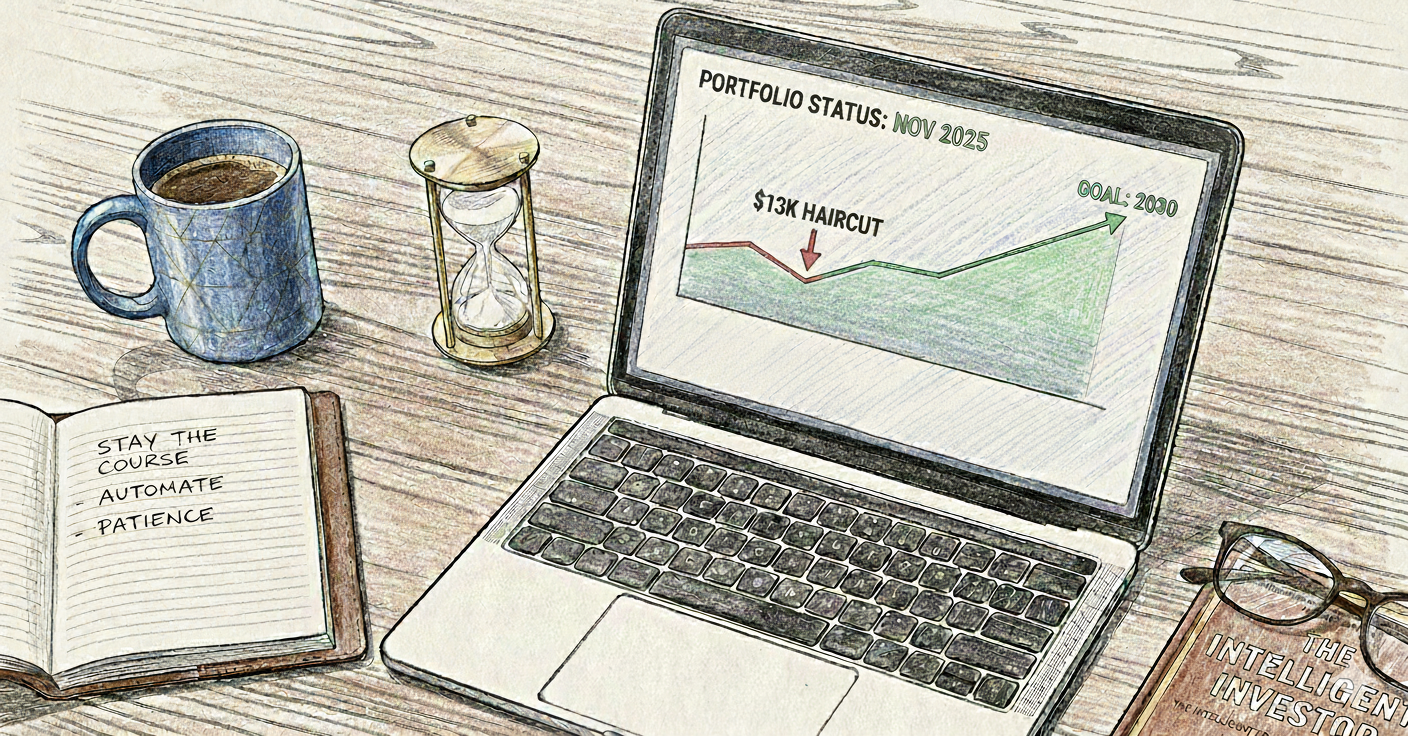
  • The $13k Haircut: Why I’m Ignoring the “Tariff Tantrum” (Nov 2025 Update)

    If you looked at the headlines in mid-November, you’d think the sky was falling. Between the 36-day government shutdown in the U.S., the renewed “tariff chaos,” and the sudden jitteriness around AI valuations, the markets have been moody.

    My portfolio felt that moodiness. For the first time in a few months, my net worth has taken a step back.

    As we stare down the barrel of December, my investable net worth is down about 2.27% from last month. Performance would have been worse if I hadn’t continued to DCA into low-cost index funds.

    The biggest drop was in crypto as it remains a highly volatile & speculative asset class. Fortunately this is a small percentage of my overall net worth. I currently have no plans to purchase more crypto.

    Investable portfolio breakdown as of November 30, 2025

    (ie. excluding primary residence, cash & emergency funds)

    Asset ClassValue (CAD)% Change vs October
    Stocks (ETFs/Individual)$720,477-0.83%
    Crypto$53,528-19%
    INVESTABLE NET WORTH$775,006-2.27%
    • Month-over-Month Change: -$12,735
    • Year-to-Date Gain: +$155,711
    • Progress to Goal: 55 Months to 2030

    What Happened in November?

    If you are tracking your own numbers, you might be wondering why the portfolio is down even though the TSX hit record highs late last week. The answer lies in two “Pragmatic” realities: Currency and Volatility.

    1. The “Tariff Tantrum” & The Shutdown

    Global markets hated the uncertainty this month. The renewed trade tensions and the prolonged U.S. government shutdown caused a sharp dip mid-month. While the S&P 500 and TSX recovered late in the month (thanks to the 2.6% GDP surprise here in Canada), my portfolio snapshot captured some of that mid-month volatility, particularly in the tech sector where AI valuations are finally coming back to earth.

    2. The Currency Headwind

    Here is a detail many Canadian investors miss: The Canadian Dollar strengthened.

    When the Loonie rises (as it did this week, trading up to ~0.72 USD), the value of my U.S. holdings drops when converted back to CAD. I own a lot of U.S. index funds. The U.S. market went up, but the currency conversion ate those gains. This is the “invisible tax” of international diversification, but it works in our favor just as often as it works against us.

    3. The Housing Cool-Down

    Real estate across Canada is officially cooling. While I haven’t written down the value of my property this month, I am not writing it up, either. The days of easy equity gains are paused as the market absorbs the current interest rate environment.

    4. The Crypto Market Crashed

    Crypto is down this year. With interest-rate cuts now looking less likely, money is moving out of riskier assets and into safer places. This creates less demand for crypto, which makes prices drop. Some traders who used borrowed money were forced to sell when prices fell, pushing the market even lower. Big investors also pulled money from crypto funds, reducing liquidity and making the market more sensitive to swings. Overall, there is a mix of economic uncertainty, less buying power, and lower confidence rather than any single dramatic event.

    The Pragmatic Take: Why I Am Not Selling

    When the headlines are screaming about trade wars and political gridlock, I turn to Warren Buffett. He famously said:

    “If you mix your politics with your investment decisions, you’re making a big mistake.”

    If I had sold during the mid-month panic when the shutdown news was at its peak, I would have locked in losses. Instead, I did nothing. Actually, I did one thing: I let my automated investments run.

    This is the power of Dollar Cost Averaging (DCA).

    Every day, regardless if markets were up or down, I bought more index fund units. I didn’t have to summon the courage to click “buy”; the system did it for me.

    In the accumulation phase, volatility is your friend. It allows you to buy more shares for the same amount of money.

    The Road to 2030

    I am currently 5 years and 1 month away from my target retirement goal.

    A $10k drop is a blip. It represents less than 2% of the portfolio.

    If you are in your 20s, this volatility is a gift—buy more.

    This is a stress test. If a 1% drop keeps you up at night, your asset allocation is too aggressive. For me, I’m sleeping just fine.

    Next Month: I’ll be doing a deep dive into my financial performance for the year & lessons learned.

    Stay the course.

    — The Pragmatic Millionaire

  • The Joy Portfolio: Investing in Activities That Compound Happiness

    Money isn’t the only way to build wealth. Time, energy, and experiences compound too. Just like a financial portfolio, the way you invest in your life determines your long-term happiness, health, and fulfillment. By practicing intentional living and focusing on lifestyle design, you can create a life that truly matters. Welcome to your Joy Portfolio.


    Why Your Time is Your Most Valuable Asset
    Life is finite—about 4,000 weeks on average. Every choice carries an opportunity cost. Saying yes to one activity often means saying no to another. Early retirement and time wealth are not just about money—they’re about reclaiming your most valuable asset: time.

    Intentional living means:

    • Recognizing what truly matters.
    • Accepting limits rather than trying to do everything.
    • Focusing on high-value joy assets that compound happiness over time.

    Building a Joy Portfolio: What to Invest In
    A Joy Portfolio is made up of “assets” that grow your well-being over time:

    • Relationships: Friends, family, mentors, and romantic connections.
    • Hobbies: Activities that spark flow and creativity, from dancing to painting.
    • Learning: Skills, languages, and knowledge that expand your mind.
    • Health Practices: Exercise, yoga, meditation, and nutrition.
    • Meaningful Work: Tasks that align with your values, even if small.

    Like financial assets, these need deliberate allocation. Random or inconsistent efforts won’t yield compounding happiness or long-term fulfillment.


    Compounding Happiness Through Daily Habits
    Small, consistent investments in your Joy Portfolio create long-term gains:

    • A weekly dance class improves fitness, mood, and social connection.
    • Spending 30 minutes daily learning a language grows skill and confidence.
    • Investing in friendships with regular meetups strengthens emotional support networks.

    These activities multiply in value, just like compound interest in a financial account. Lifestyle design and structured routines help ensure your daily actions align with your values.


    Rebalance Your Life for Maximum Fulfillment

    1. Track Your Activities: Note what makes you feel energized, satisfied, or happy.
    2. Schedule Joy: Treat high-value activities as non-negotiable appointments.
    3. Review and Rebalance: Periodically assess your portfolio. Shift time from low-return activities to high-return ones.
    4. Start Small: Even 10–20 minutes daily in a joy asset compounds over months and years.

    By prioritizing what truly matters, you create time wealth and ensure your life aligns with your vision for early retirement and intentional living.


    Conclusion
    Wealth isn’t only money. Time and experiences are equally valuable assets. By intentionally investing in your Joy Portfolio, you can maximize happiness, fulfillment, and purpose.

    Call-to-Action:
    Start designing your Joy Portfolio today. What three activities will you invest in this week that will grow your long-term happiness and help you live intentionally?

    Stay the course.

    — The Pragmatic Millionaire


    References & Further Reading: